


 1-888-645-7920
- * Cruises *
- Australia/ New Zealand
- * Group Travel *
- Alaska
- Alicante
- Amsterdam
- Antigua
- Argostoli
- Athens
- Barcelona
- Bari
- Belfast
- Berlin
- Bologna
- Bruges
- Brussels
- Budapest
- Caribbean
- South America
- Chianti
- Cinque Terre
- Copenhagen
- Corfu
- Dubai
- Dublin
- Dubrovnik
- Edinburgh
- Egypt
- Ephesus
- Florence
- Genoa
- Helsinki
- Iceland
- India
- Interlaken
- Israel
- Istanbul
- Italy
- Katakolon
- Klaipeda
- Koper
- Kotor
- La Spezia
- Lake Como
- Liverpool
- Livorno
- London
- Lyon
- Madrid
- Milan
- Malaga
- Marseilles
- Monte Carlo
- Mykonos
- Naples
- Nice
- Normandy
- North America
- Palma de Mallorca
- Paris
- Prague
- Ravenna
- Rhodes
- Rome
- Salzburg
- Santorini
- Sicily
- Siena
- Sorrento
- Split
- St. Petersburg
- Stockholm
- Tallinn
- Toulon
- Tuscany
- Valencia
- Valletta
- Venice
- Vienna
- Zurich


Istanbul Disabled Access Review
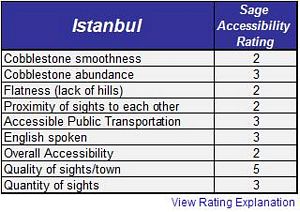 By John Sage
Disabled access in Istanbul is the result of the long history of the city, the topography, and the current building codes. People have been living in this location for over 2500 years, and many streets and buildings date back several centuries long before there were building codes for disabled access in Istanbul.
Istanbul Disabled Access – Best Aspects
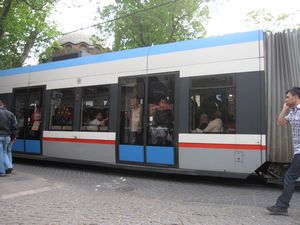
Accessible tram runs though center of town – There is an inexpensive tram line (shown in the image on the right) that runs through the Old Town that can be beneficial to disabled tourists. The tram goes up some hills that wheelchair tourists will not have to push up. It runs near the Blue Mosque, Hagia Sophia, Basilica Cistern, and Grand Bazaar
An unspoiled gem – Istanbul is truly an underappreciated destination for many tourists from western countries. Many people visit Europe by traveling to the big cities in the west (London, Paris, Rome, Venice) without taking the time to head east to Istanbul. Istanbul has just as much history as Rome and provides one of the easiest ways to visit a Muslim country.
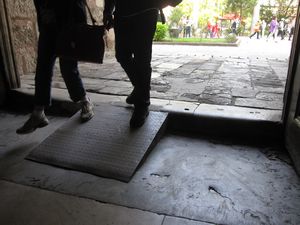
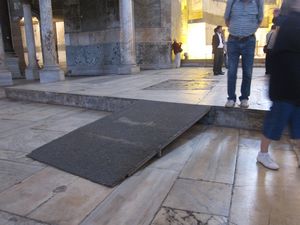
The two most famous tourist attractions are moderately accessible – Most wheelchair tourists will have little problems visiting the Blue Mosque and the Hagia Sophia. A wheelchair ramp is located at an entrance on the northwest side of the Blue Mosque. Because the carpet inside is hand-woven and decades old, wheelchair users will have to transfer out of their own wheelchair and into a wheelchair that the staff provides. The nearby Hagia Sophia has wheelchair ramps at the entrance (shown in the images below) although there are a couple of single steps to navigate.
 |
 |
Proximity of the big attractions – The most popular attractions in Istanbul (Hagia Sophia, Blue Mosque, Basilica Cistern, and Topkapi Palace) are within walking/rolling distance of each other. There are wheelchair accessible routes between them.
2600 years of history – Istanbul has been an important city for centuries. Consequently, there is an enormous amount of sights to see and things to do in Istanbul. Disabled tourists will be able to visit numerous museums, mosques, and palaces set in a beautiful city. There is easily a week worth of accessible sites to visit in Istanbul, and disabled visitors can see it all without having to switch hotels.
Istanbul Disabled Access – Most Challenging Aspects
Istanbul hills – The strategic location of Istanbul (and consequently its historical importance) is partially due to the defensive advantages its hills have provided over the centuries. The cliffs between the Topkapi Palace and the Bosporus are the most noticeably example of the steep terrain. Hills are also found throughout the Old Town near the Blue Mosque and the Grand Bazaar (one of the hills in the back of the Topkapi Palace is shown in the video below. John needs to be in a wheelie to prevent catching a front wheel on one of the cobblestones). Taksim Square in the New District is located on top of another large hill.
 Completely inaccessible toilets – Turkey presents one of the more unique challenges for disabled tourists in Europe. Some of the public toilets are not what most tourists would consider toilets at all. They are just holes in the ground that people can squat over. There are two spots for people to position their feet and there is nothing at all to sit on (shown in the photo on the right).
Few accessible public transportation options – Accessible metro stations are few, accessible buses are hard to find, and the funicular is not accessible. Overall, getting around Istanbul with a disability is challenging without using a wheelchair accessible taxi.
Crowded tram – Although many of the tram stations are accessible, the trams tend to be completely packed with people many times of the day. Often there is no room to fit even one more person standing, much less someone sitting in a wheelchair.
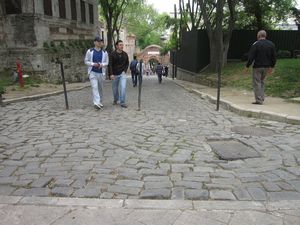
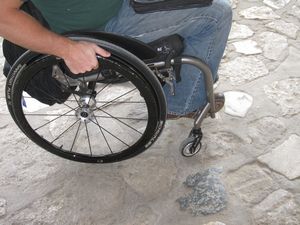
Severe cobblestones in parts of the Old Town – The oldest part of the city, as expected, has some very old cobblestones that have been weathered over the years. Cobblestones are found near Blue Mosque and the Hagia Sophia. The most severe cobblestones are near the Grand Bazaar. Disabled access in Istanbul Old Town can be challenging, and wheelchair users may need assistance in this part of town.
 |
 |
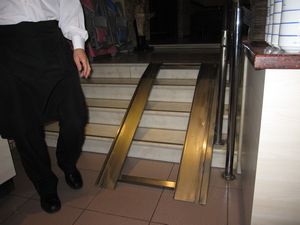
Poor national accessibility standards – While accessibility in Turkey is improving, it generally lags behind western European countries. The lack of a national, comprehensive, and strongly-enforced system of accessibility standards can cause disabled visitors to encounter some surprises on their trip. Many individual business owners do their best to make their building accessible, but some are a little short of western accessibility standards as illustrated by the hotel ramp shown in the picture below.
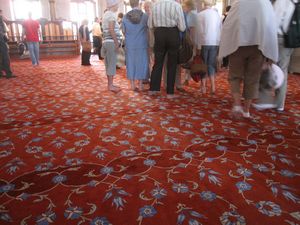
Need to transfer out of wheelchair at Blue Mosque – The floor of the Blue Mosque is covered in an immaculate 100 year old carpet (shown in the picture below on the left). As in all mosques, visitors must take off their shoes. Wheelchair users at the Istanbul Blue Mosque need to transfer to a manual wheelchair that the staff provides so as not to track any dirt onto the carpet (shown in the picture below on the right).
 |
 |
Have questions about Istanbul accessibility?
Our Istanbul accessible travel consultants have all the answers.
Read more:
Istanbul Accessible Travel – main page
Pros and Cons of Istanbul Disabled Access
9 Wheelchair Accessible Travel Tips for Istanbul Turkey
8 Keys to Success for Istanbul Disabled Travel
Istanbul Cruise Port Disabled Access Review
Hagia Sophia Disabled Access Review
Blue Mosque Wheelchair Accessibility
Disabled Access at Istanbul Topkapi Palace
Travel Insurance for Disabled Travelers
Istanbul Accessible Travel Packages
Accessible Walking and Driving Tours in Istanbul
Sultanahmet Istanbul Accessible Private Tour
Panoramic Istanbul Wheelchair Accessible Tour
Half-day Highlights of Istanbul Handicap Accessible Tour
Half-day Turkish Istanbul Accessible Guided Tour
Old City Istanbul Accessible Group Tour
Blue Mosque Istanbul Accessible Cruise Excursion by Tram
Highlights of Istanbul Accessible Shore Excursion by Tram
Turkish Istanbul Accessible Walking Tour by Tram
Accessible Hotels in Istanbul
Istanbul Accessible Hotel Rooms
Istanbul Handicapped Accessible Hotel
Wheelchair Accessible Hotel in Istanbul
Disabled Hotel Rooms in Istanbul Turkey
Wheelchair Accessible Hotel Rooms in Istanbul
Handicapped Accessible Hotel in Istanbul
Istanbul Accessibility Guide by John Sage
Istanbul Trip Planning by Sage Traveling – Travel with Ease!
Accessible Cruising with Sage Traveling – Receive our Istanbul Accessibility Guide & Istanbul accessible hotel recommendations for free!
Contact our Istanbul accessible travel consultants

"We could go on and on but this was the best trip that we could ask for. Our next trip will definitely be through you..."Read More...
"The Paris Accessibility Guide is the most valuable travel document I have ever encountered…"Read More...
"We had a splendid time in Europe, thanks to all your planning. We remarked again and again how difficult it would have been without your planning! Thanks again for the wonderful trip!"Read More...
"I wanted to let you and Mr. Sage know that we loved our accessible private tour of the Vatican…"Read More...
"Let me thank all you guys at Sage Traveling. I got my scooter in Berlin. It was a brand new Orion…"Read More...
"I am a wheelchair user and have just returned with my husband from a cruise which started in Istanbul and ended in Venice. The information you provided on both these cities was absolutely invaluable…"Read More...
"The hotel you recommended was very centrally located and within convenient walking distance to the Louvre and Notre Dame. We even walked to the Latin quarter and to the boat tour! Thank you again for making our trip a wonderful and manageable experience…"Read More...
"I just wanted to thank you for an excellent experience in Paris. The wheelchair was delivered exactly on time and we’ve been everywhere with it over the last two days…"Read More...
"We will certainly recommend your services to others and use you again in the future…"Read More...