


 1-888-645-7920
- * Cruises *
- Australia/ New Zealand
- * Group Travel *
- Alaska
- Alicante
- Amsterdam
- Antigua
- Argostoli
- Athens
- Barcelona
- Bari
- Belfast
- Berlin
- Bologna
- Bruges
- Brussels
- Budapest
- Caribbean
- South America
- Chianti
- Cinque Terre
- Copenhagen
- Corfu
- Dubai
- Dublin
- Dubrovnik
- Edinburgh
- Egypt
- Ephesus
- Florence
- Genoa
- Helsinki
- Iceland
- India
- Interlaken
- Israel
- Istanbul
- Italy
- Katakolon
- Klaipeda
- Koper
- Kotor
- La Spezia
- Lake Como
- Liverpool
- Livorno
- London
- Lyon
- Madrid
- Milan
- Malaga
- Marseilles
- Monte Carlo
- Mykonos
- Naples
- Nice
- Normandy
- North America
- Palma de Mallorca
- Paris
- Prague
- Ravenna
- Rhodes
- Rome
- Salzburg
- Santorini
- Sicily
- Siena
- Sorrento
- Split
- St. Petersburg
- Stockholm
- Tallinn
- Toulon
- Tuscany
- Valencia
- Valletta
- Venice
- Vienna
- Zurich


Disabled Access Review of Rome
By John Sage
 Rome Disabled Access – Ancient Roman ruins, spectacular renaissance art, and fabulous Italian dining make Rome one of the most popular tourist destinations in the world. Disabled travelers will encounter several challenges in Rome including uneven ground in the Roman ruins, cobblestones on the streets, and few accessible transportation options.
Although Rome disabled access is not as good as other European cities, accessibility at Roman tourist attractions, restaurants, and hotels is sufficient to ensure that accessible holidays are possible for people with all types of disabilities.
Disabled Access in Rome – Best Aspects
World Class Destination – Rome is the 3rd most popular city for tourists in Europe….and there’s a reason for it. The ancient ruins, Renaissance art, and Vatican City are absolutely spectacular. Many cities in Europe present accessibility challenges….in Rome it’s worth tackling them.
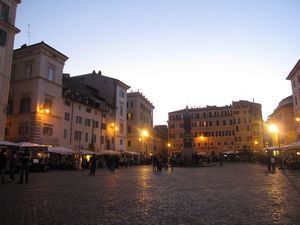 Accessible Dining Options – In several areas of the city, numerous restaurants with outdoor accessible dining are grouped in a single place. Rather than search block after block for a Rome wheelchair accessible restaurant, you can plan your day to finish at places like the Piazza Navona or Campo de Fiori (shown in the picture on the right) for numerous accessible restaurants to choose from. Many of our Rome wheelchair accessible hotels are located near accessible restaurants.
You can bypass the steep ramp – In 2009, an outdoor elevator was installed at the Roman Forum so wheelchair tourists will no longer need to push up the long steep ramp to get up to the street level. Accessibility at the Roman Forum is some of the most challenging in the city.
Accessible Tours in Rome – The sights in Rome are spectacular and the history behind the sights are even better. A variety of accessible walking and driving tours are available in Rome. You can choose from accessible group tours and accessible tours with a private guide.
The Eternal City – Rome has been around for a long time giving disabled tourists plenty of things to see and do. Disabled tourists can easily spend a week here without ever needing to switch hotels or move between cities.
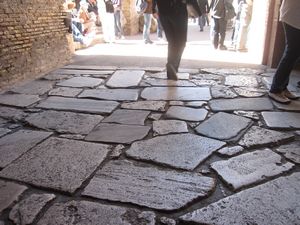
The gladiators had to use the stairs – But disabled tourists at the Coliseum can use the elevator! A step-free entrance leads past the ticket window to the elevator. The biggest challenge for wheelchair access at Rome’s Coliseum is a small stretch of cobblestones in the interior (shown in the picture on the right).
Why settle for just one city? – Rome has easy connections by train to Florence (1.5 hours), Naples (2 hours), and Venice (3.5 hours).
Disabled Access in Rome – Most Challenging Aspects
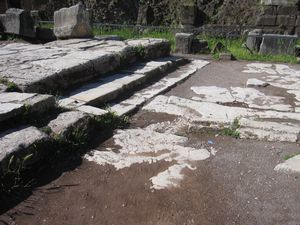 A bumpy ride – The cobblestones date back hundreds of years and some of the ruins date back thousands of years….and they haven’t withstood the effect of time too well. The uneven ground and enormous uneven paving stones near the Roman Forum, Coliseum, and Apian Way present challenges to wheelchair users (picture shown on the right). The central part of Rome where the Pantheon, Trevi Fountain, and Spanish Steps are found have cobblestones with 3 star smoothness which make getting around Rome in a wheelchair difficult (video shown below).
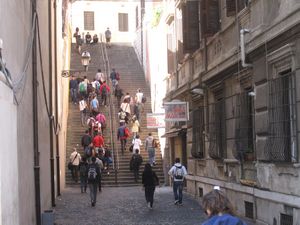 The City of 7 Hills – Rome did not get the name “the city of 7 hills” for no reason. Some of the hills are quite steep, and the streets and sidewalks going up them can present problems for manual wheelchair users and other disabled tourists visiting Rome. In other places, you may be traveling along a sidewalk to be met by a flight of stairs to continue to the next street (an example of this is shown in picture on the right).

 Medieval streets – Central Rome which houses the Pantheon, the Piazza Navona, and the Campo de Fiori was originally a swamp that was drained by the Romans. You can easily see from the map on the right that the neighborhood follows a medieval street plan with narrow streets that wind and aren’t laid out systematically. In this part of Rome, it can be difficult to navigate from attraction to attraction and there are virtually no sidewalks. You’ll need to share the cobblestone streets with the cars (shown in the image on the lower right).
Lots of history spread out over a large city – As the city of Rome grew over the centuries, new buildings were built in different parts of the city. Consequently, the major tourist attractions are quite spread out. The Pantheon is located in the middle of the city, the Vatican is across the Tiber River to the west, and other attractions like the Coliseum and Baths of Diocletian are further to the east. The distance from the Baths of Diocletian in the east to the Vatican in the west is 4 km (2.5 miles). Unlike other Italy accessible cities, in Rome wheelchair tourists will need accessible transportation to move between the various parts of the city.
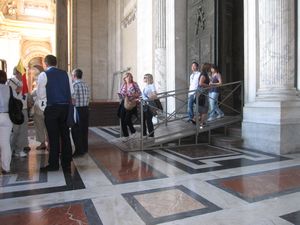
2 Vatican entrances – Visiting Vatican City takes at least a half a day. Unfortunately, Rome disabled tourists will have to use two separate entrances. The Vatican Museums and Sistine Chapel are accessed by the entrance on the north side of Vatican City on Viale Vaticano street. The accessible entrance to St. Peter’s Basilica is located on St. Peter’s Square on the east side of Vatican city (ramp into church shown on the right). Most tourists can get between the Sistine Chapel and St. Peter’s Basilica using a flight of stairs, but disabled tourists will need to take a 15 minute walk/roll along the outside of the city to get between the two.
Few accessible public transportation options – The large distances between tourist attractions and the presence of cobblestones and hills make it necessary to use accessible transportation in Rome. Unfortunately, there are few accessible public transportation options in Rome. There are only 3 metro lines with only a few accessible metro stations. Additionally, only a few accessible bus lines exist.
Want a 100% Accessible Vacation?
View our Rome Accessible Travel Packages
Read more:
Rome Accessible Travel – main page
Pros and Cons of Rome Disabled Access
10 Wheelchair Accessible Travel Tips for Rome Italy
10 Keys to Success for Rome Disabled Travel
Getting Around Rome with a Disability
Vatican Handicapped Access Review
Wheelchair Accessibility at the Colosseum
Handicapped Access at the Roman Forum
Civitavecchia Port Disabled Access Review
Best and Worst Aspects of Disabled Travel in Italy
Top 10 Experiences for Disabled Visitors to Italy
12 Wheelchair Travel Tips for Italy
Travel Insurance for Disabled Travelers
Rome Accessible Travel Packages
Accessible Walking and Driving Tours in Rome
Wheelchair Accessible Vatican Tour
Ancient Rome Accessible Tour
Accessible Guided Tour in Rome City Center
Vatican Wheelchair Accessible Guided Tour – 5 Hours
Vatican Wheelchair Accessible Guided Tour – 3 Hours
Roman Forum and Colosseum Accessible Tour
Accessible Guided Walking Tour in Rome – 5 Hours
Wheelchair Accessible Walking Tour – Rome in a Day
Accessible Borghese Gallery Tour
Disabled Tour of the Capitoline Museums
Accessible Wine Tasting Tour in Rome
Disabled Rome Golf Cart Tour
Rome Wheelchair Accessible Van Tour – Full Day
Rome Handicapped Driving Tour – 5 Hours
Rome at Night Handicapped Driving Tour
Civitavecchia (Rome) Cruise Excursions for the Disabled
Best of Accessible Rome Cruise Excursion
Vatican & Essential Rome Accessible Shore Excursion
Vatican & Ancient Rome Accessible Driving Tour
Renaissance, Baroque, and Ancient Rome Accessible Cruise Excursion
Vatican and St. Peter’s Accessible Shore Excursion
Vatican City Handicapped Shore Excursion
Rome Highlights Accessible Excursion by Train
Ancient Rome Wheelchair Accessible Cruise Excursion
Accessible Hotels in Rome
Rome Accessibility Guide by John Sage
Rome Trip Planning by Sage Traveling – Travel with Ease!
Accessible Cruising with Sage Traveling – Receive our Rome Accessibility Guide & Rome accessible hotel recommendations for free!
Contact our Rome accessible travel consultants

"We could go on and on but this was the best trip that we could ask for. Our next trip will definitely be through you..."Read More...
"The Paris Accessibility Guide is the most valuable travel document I have ever encountered…"Read More...
"We had a splendid time in Europe, thanks to all your planning. We remarked again and again how difficult it would have been without your planning! Thanks again for the wonderful trip!"Read More...
"I wanted to let you and Mr. Sage know that we loved our accessible private tour of the Vatican…"Read More...
"Let me thank all you guys at Sage Traveling. I got my scooter in Berlin. It was a brand new Orion…"Read More...
"I am a wheelchair user and have just returned with my husband from a cruise which started in Istanbul and ended in Venice. The information you provided on both these cities was absolutely invaluable…"Read More...
"The hotel you recommended was very centrally located and within convenient walking distance to the Louvre and Notre Dame. We even walked to the Latin quarter and to the boat tour! Thank you again for making our trip a wonderful and manageable experience…"Read More...
"I just wanted to thank you for an excellent experience in Paris. The wheelchair was delivered exactly on time and we’ve been everywhere with it over the last two days…"Read More...
"We will certainly recommend your services to others and use you again in the future…"Read More...